
You arrive in the Dolomites expecting a gentle summer walk and find yourself at 2,400 metres, staring at dark clouds over a trail with no quick exit. July can be an excellent first hiking month, but only if you match the route, rifugio, and transport plan to your actual fitness.
Which Dolomites routes suit beginners in July?
The best first-day choice: Alpe di Siusi
For a first Dolomites hike, pick the Alpe di Siusi rather than a dramatic high route. The Hans and Paula Steger Trail between Compatsch and Saltria crosses open alpine meadows with little climbing, clear signposts, and several places to stop. The official local description calls it easy, with hardly any steep sections. That matters more than a famous viewpoint when your legs are still adjusting to altitude.
The postcard routes with a catch
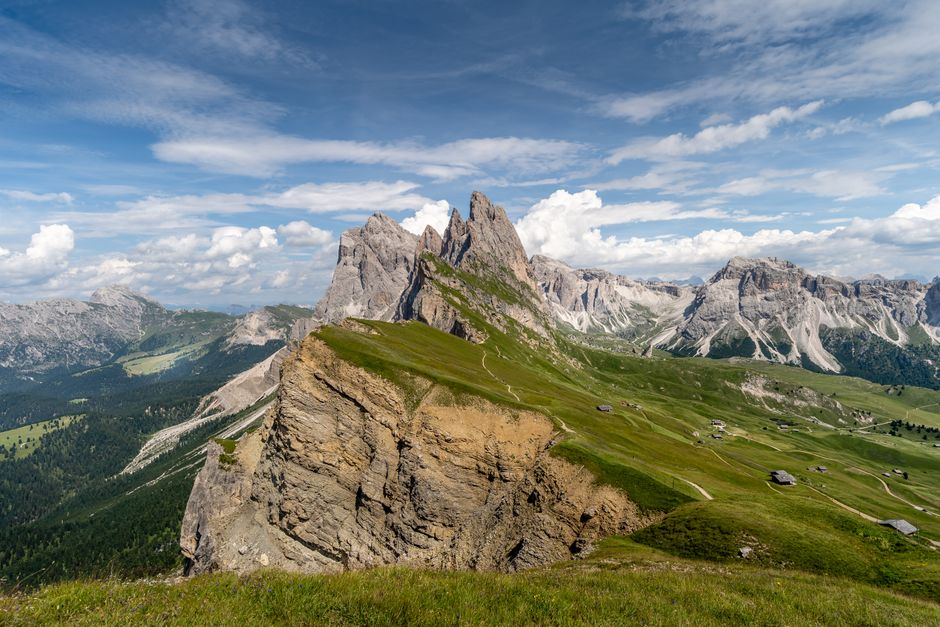
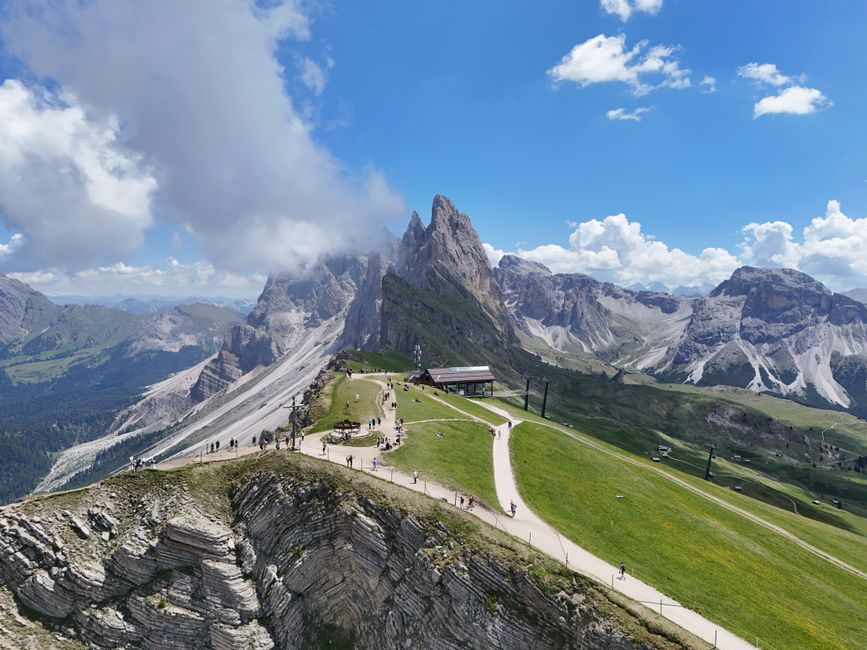
Seceda is the best lift-assisted option. The ridge section is about 1 kilometre and takes roughly one hour, while the summit reaches 2,519 metres. The return Seceda lift ticket is listed at €74 from 11 July to 23 August 2026, so the convenience has a real cost. The Tre Cime circuit is more dramatic but less forgiving: about 9.5 kilometres, 468 metres of ascent, and around 3.5 hours from Rifugio Auronzo, with the trail reaching Forcella Lavaredo at 2,454 metres.
| Route | Distance and effort | July cost or issue | Verdict |
|---|---|---|---|
| Alpe di Siusi Steger Trail | Easy, gentle gradients, flexible length | Lift and bus fees vary | Best first hiking day |
| Seceda ridge | About 1 km on the ridge; 2,519 m summit | €74 return lift from 11 July | Best views for limited effort |
| Tre Cime loop | 9.5 km, 468 m ascent, 3.5 hours | Crowds and high-altitude exposure | Best after one easier day |
| Adolf Munkel Trail | About 12.2 km, around 3.5 hours | Longer day; check trail status | Best for steady walkers |
The Adolf Munkel Trail near the Geisler peaks is a strong second or third hike because it combines forest, meadows, and views without the exposed feel of a high pass. My clear ranking is Alpe di Siusi for day one, Seceda for the easiest iconic panorama, and Tre Cime only after you have tested your pace.
Is July the best month for a first Dolomites hike?
The reason to choose July
July gives beginners long daylight, open summer lifts, flowering meadows, and a much better chance of finding open mountain restaurants and rifugios than in early June, so it is the right month for travellers with fixed dates who want transport choices and a first hike that can be shortened when the weather turns.
The price of choosing July
July is also peak season, and the most photographed trails can feel like walking routes through a busy attraction rather than quiet mountain paths, while afternoon thunderstorms, leftover snow on shaded passes, and sudden temperature drops make a sunny valley forecast an unreliable safety plan; my verdict is to hike before 9 a.m., keep one low route in reserve, and avoid booking a demanding pass as your arrival-day activity.
How should beginners book a Dolomites rifugio?
Book the bed before building the route
A rifugio is a mountain shelter, not a hotel with a guaranteed private bathroom, room service, or late check-in. Start with the hut’s own opening dates and reservation rules, then build a route that reaches the door by mid-afternoon. Do not draw a seven-day Alta Via itinerary first and assume every overnight stop will accept your dates. In July, popular huts can fill months ahead, and each one uses a different booking process.
Rifugio Puez lists 2026 half-board at €90 for non-members and €72 for CAI or reciprocal Alpine Club members; bed and breakfast is €50, while a 2.5-minute hot shower costs €4. Rifugio Rosetta lists summer 2026 half-board at €80 for non-members, with 70 beds and a €7 shower when water supplies allow it. Rifugio Auronzo lists July half-board at €95 for a dormitory bed. These prices usually cover dinner and breakfast, but drinks, packed lunches, transport, and tourist taxes may sit outside the headline number.
The sensible first overnight plan
For a first hut experience, choose one night at a well-connected refuge after a short approach, not a remote two-night traverse. Rifugio Puez works for hikers already comfortable with a long day in the Puez-Odle area; Rifugio Rosetta gives access to the Pale di San Martino but still requires mountain stamina; Rifugio Auronzo is convenient for Tre Cime, yet its location also means heavy daytime traffic.
Use the Rifugio Puez 2026 price page and the Rifugio Rosetta summer information as starting points, then confirm the arrival time, cancellation rule, sleeping-bag-liner requirement, payment method, and meal schedule directly with the hut. A reservation is not useful if you cannot reach it safely before dinner.
What should beginners pack for July hiking?
Spend money on grip, rain protection, and navigation before buying a large backpack or expensive camera. The mountain does not care how warm the valley felt at breakfast.
- Use real hiking footwear. The Salomon X Ultra 4 Mid GTX gives beginners a waterproof mid-height boot with a grippy outsole; expect roughly €150 to €180, depending on the retailer. Trail runners work on dry meadow paths, but they are a poor choice for wet rock, loose descents, or a heavy overnight pack.
- Carry a small pack. An Osprey Talon 22 has 22 litres of capacity and is enough for a day route with water, food, a shell, and warm layers. For one hut night, move up to a 30- to 40-litre pack rather than cramming gear into a 20-litre bag.
- Bring poles for descents. Black Diamond Trail Back poles adjust to about 63–140 centimetres and reduce stress on knees during long downhill sections. They are not a substitute for balance on steep terrain, but they are useful insurance on wet paths.
- Carry two layers for the top. A lightweight fleece and waterproof shell matter more than a thick cotton sweatshirt. At 2,400 metres, wind and rain can make a warm July afternoon feel cold within minutes.
- Carry water and a backup snack. Pack at least 1.5 litres for a normal day, more for exposed routes, and keep cash because some huts have weak card connections or no reliable signal.
- Download the route before leaving. A Garmin inReach Mini 2 weighs about 100 grams and provides two-way satellite messaging with a subscription, but it is an emergency backup, not permission to ignore the forecast or trail signs.
Skip cotton jeans, brand-new boots, and a heavy drone. The Puez-Odle Nature Park restricts drone use, and new footwear can ruin an otherwise sensible itinerary through blisters.
Which rifugio and base are best for a first trip?
Should beginners stay in a valley hotel?
Yes. Val Gardena is my strongest base recommendation because lifts, buses, meadow walks, Seceda, and several short routes sit within one transport network. Sleep in Ortisei, Santa Cristina, or Selva, then choose a different hike each morning. This costs more than a dormitory bed on some dates, but it removes the pressure of carrying all your luggage and arriving at a remote hut before a fixed dinner time.
Should beginners sleep at Tre Cime?
Only if the reservation is already confirmed and the forecast is stable. The Tre Cime loop is manageable for a fit beginner starting from Rifugio Auronzo, but the altitude, exposed terrain, crowds, and limited escape options make it a poor first walk after a long drive. Start with Rifugio Lavaredo and Rifugio Locatelli as lunch stops, then decide if an overnight stay makes sense.
When should you skip a rifugio entirely?
Skip the overnight booking if you dislike shared dormitories, cannot carry a liner, need a private bathroom, or have no flexibility for a weather delay. A valley base gives you a room, luggage storage, easier transport, and a safer way to cancel a hike. This is not financial advice; it is trail-planning advice, and the cheapest bed is not a bargain if it forces you onto a dangerous route.
For the traveller who arrives in July hoping for one manageable mountain day, the answer is simple: base in Val Gardena, start with Alpe di Siusi or lift-assisted Seceda, and save Tre Cime for the second clear morning. That plan keeps the famous views while leaving enough margin for weather, tired legs, and the part of the Dolomites that brochures rarely price in: getting back down safely.